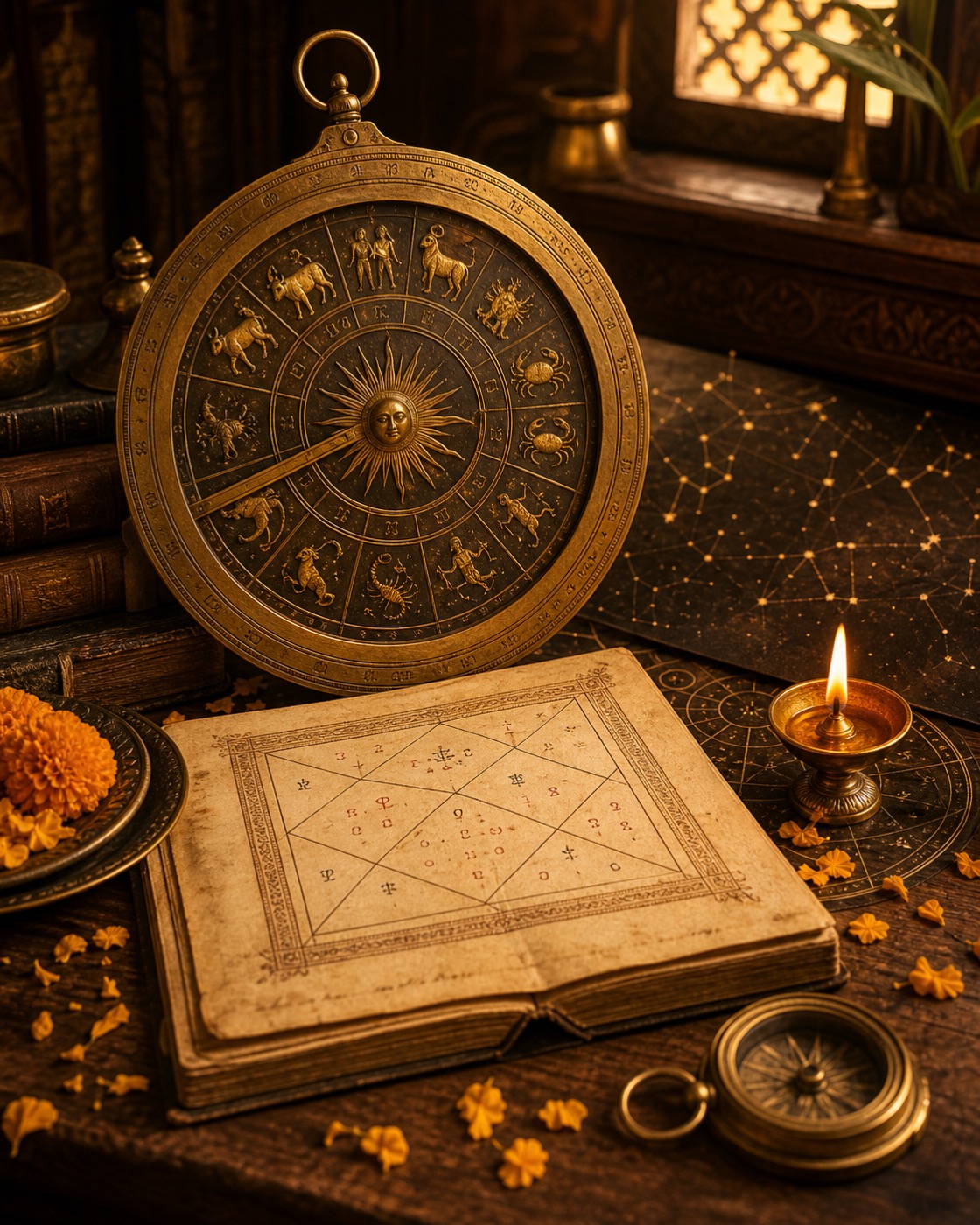

Vimshottari dasha is a 120-year planetary period system described in Brihat Parashara Hora Shastra. The first mahadasha is ruled by the lord of the Moon's birth nakshatra, and its balance depends on how much of that nakshatra the Moon has left to travel. Each mahadasha divides into antardashas and pratyantar dashas in the same proportions, giving the astrologer a timeline to the day.
Why the calculation matters
Most chart readings eventually reach the question "when?" Vimshottari dasha is the timing system Parashari astrologers reach for first. It is simple in principle and easy to get slightly wrong in practice: a Moon a few minutes of arc off, or the wrong year length, moves an antardasha by weeks. This guide shows how the numbers are built so you can check any calculator, including ours.
The nine periods and their order
Vimshottari ("one hundred and twenty") gives each graha a fixed number of years. The order never changes:
Graha | Years | Nakshatras ruled |
|---|---|---|
Ketu | 7 | Ashwini, Magha, Mula |
Shukra (Venus) | 20 | Bharani, Purva Phalguni, Purva Ashadha |
Surya (Sun) | 6 | Krittika, Uttara Phalguni, Uttara Ashadha |
Chandra (Moon) | 10 | Rohini, Hasta, Shravana |
Mangal (Mars) | 7 | Mrigashira, Chitra, Dhanishta |
Rahu | 18 | Ardra, Swati, Shatabhisha |
Guru (Jupiter) | 16 | Punarvasu, Vishakha, Purva Bhadrapada |
Shani (Saturn) | 19 | Pushya, Anuradha, Uttara Bhadrapada |
Budh (Mercury) | 17 | Ashlesha, Jyeshtha, Revati |
The total is 120 years. After Budh the cycle returns to Ketu.
Step 1: the starting dasha and its balance
Find the nakshatra the Moon occupies at birth. Its lord rules the first mahadasha. Each nakshatra spans 13°20'. The portion the Moon has not yet travelled is the portion of that mahadasha still to run.
Worked example on a sample chart: the Moon is at 10°00' Mesha, in Ashwini (0°00' to 13°20'). It has 3°20' left, which is one quarter of the nakshatra. Ketu's mahadasha is 7 years, so the balance at birth is 7 × 1/4 = 1.75 years, about 1 year 9 months. Shukra's 20-year mahadasha follows, then Surya, and so on.
Step 2: antardasha (bhukti)
Each mahadasha divides into nine antardashas, starting with its own lord and following the same order. The length of an antardasha is:
mahadasha years × antardasha years ÷ 120
So Shukra mahadasha, Surya antardasha = 20 × 6 ÷ 120 = 1 year. Ketu-Ketu = 7 × 7 ÷ 120 = 0.408 years, about 4 months 27 days.
Step 3: pratyantar dasha (third level)
The same rule applies one level down. The pratyantar inside an antardasha is:
antardasha length × pratyantar years ÷ 120
Below that come sookshma and prana dashas, which BPHS also describes. For event timing most practitioners work to the pratyantar, and use sookshma only when the birth time is well rectified.
Settings that change the dates
Two calculators can show different dates for the same chart. Check these before you blame either one:
- Ayanamsa. Lahiri (Chitrapaksha) is the common default; KP users often use the KP ayanamsa. A different ayanamsa shifts the Moon and therefore the balance.
- Year length. Some software uses a 365.25-day solar year, others a 360-day savana year. Over a 20-year mahadasha the difference adds up to months.
- Birth time. The Moon moves roughly half a degree an hour, so a one-hour error shifts the balance noticeably.
Bodhlok calculates with the Swiss Ephemeris and lets you choose the ayanamsa. The dasha table shows which settings are in use.
Timing an event: the practitioner's sequence
The dasha shows when a theme in the chart can become active. It does not override the chart. A working sequence:
- Judge the promise first: is the matter shown in D1 and in the relevant divisional chart (D9 for marriage, D10 for career)?
- Identify the mahadasha and antardasha lords and their relationship to the houses in question: ownership, placement, aspects, and their dispositors.
- Check the strength of those lords (Shadbala, Ashtakavarga, dignity in D9).
- Narrow to the pratyantar whose lord also connects to the matter.
- Confirm with gochar: transits of Shani and Guru over the relevant houses and lords often coincide with the dasha window.
A dasha lord that rules or occupies the relevant house tends to bring that house's matters forward. A weak or afflicted lord can show the same theme with delays. Individual results always depend on the whole chart.
Seeing it on the desk
On Bodhlok the Vimshottari timeline runs from mahadasha to pratyantar on one screen, beside D1 and the divisional charts. Click a period and the desk highlights its lord in every chart. Ashtottari and Yogini dashas are there for comparison. The AI consult reads the running dasha only after the calculation and rule layers have done their work, and the conclusion stays with the astrologer.
Try it on a sample chart in the free desk at bodhlok.com.
Frequently asked questions
How is Vimshottari dasha calculated?
The first mahadasha belongs to the lord of the Moon's birth nakshatra. Its remaining balance equals the unfinished portion of that nakshatra multiplied by the lord's dasha years; the other periods follow in a fixed 120-year order.
How do I calculate antardasha duration?
Multiply the mahadasha lord's years by the antardasha lord's years and divide by 120. For example, Shukra mahadasha with Surya antardasha is 20 × 6 ÷ 120 = 1 year.
What is pratyantar dasha?
Pratyantar is the third level of Vimshottari dasha, a subdivision of the antardasha in the same proportions. Practitioners use it to narrow the timing of an event to weeks.
Why do different software show different dasha dates?
Usually because of the ayanamsa, the year length (365.25 or 360 days) or the birth time. Check those settings before comparing results.
Which classical text describes Vimshottari dasha?
Brihat Parashara Hora Shastra (BPHS) describes Vimshottari and calls it the most widely applicable nakshatra dasha for the present age.
Bring the method to a sample chart
Open the desk, load a sample chart and follow the steps above screen by screen. The free desk has everything this guide uses.