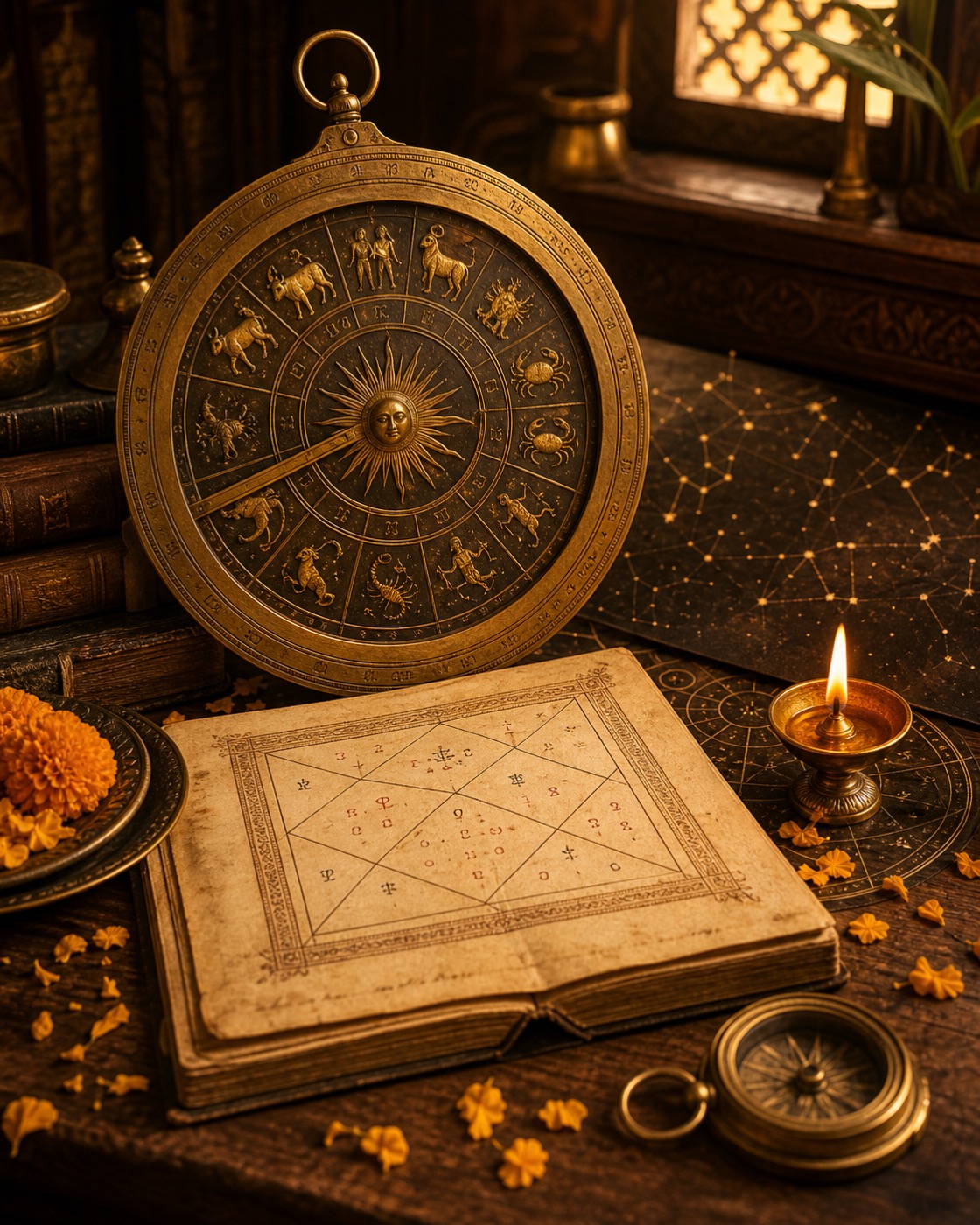

A muhurta calculator narrows a date range to candidate times in stages. First it filters the Panchang (tithi, vara, nakshatra, yoga, karana) for the purpose of the work. Then it checks the person's own chart through Tarabala and Chandrabala. Finally it tests the lagna at the chosen moment. The astrologer still weighs the shortlist, because a calendar's auspicious tick is not yet a muhurta.
Why a calendar day is not a muhurta
Families often arrive with a list of "shubh" dates from a printed Panchang. Those lists are a reasonable first filter, but they are generic. They do not know the person's janma nakshatra, the Moon's position from their natal Moon, or which lagna will be rising at the hour the work begins. Classical muhurta, as taught from texts such as Muhurta Chintamani, works in layers: the day, then the person, then the moment.
Done by hand for a month of dates, this takes hours. The method itself is not complicated; it is repetitive. That is exactly the part software should take on, leaving the judgement with the astrologer.
Stage 1: State the requirement
Every muhurta begins with the purpose, because the rules change with it. A griha pravesh, a business opening, a vehicle purchase, a marriage and a journey each favour different nakshatras and tithis. Write down:
- the purpose of the work;
- the person (or people) for whom it is being chosen, with birth details;
- the date range and the location where the work will begin.
Location matters because sunrise, and therefore the vara and the timing of every Panchang element, depends on it.
Stage 2: Filter the Panchang
The five limbs, read for the location's sunrise:
- Tithi: most traditions avoid the Rikta tithis (Chaturthi, Navami, Chaturdashi) and Amavasya for auspicious beginnings.
- Vara: the weekday's lord is matched to the purpose.
- Nakshatra: classical texts group nakshatras by nature. Dhruva (fixed) nakshatras such as Rohini and the three Uttaras suit lasting work like foundations; Chara (movable) ones such as Swati and Shravana suit travel and vehicles; Kshipra (light) ones such as Ashwini, Pushya and Hasta suit quick beginnings and trade; Mridu (soft) ones such as Mrigashira, Chitra, Anuradha and Revati suit arts and gentle work.
- Yoga and karana: inauspicious yogas such as Vyatipata and Vaidhriti are generally avoided, as is Vishti karana (Bhadra).
Practitioners also remove eclipse days and, for many purposes, periods such as Rahu Kalam within the day.
Stage 3: Test it against the person
A day that is good for everyone can still be weak for this person. Two checks are standard:
- Tarabala: count from the person's janma nakshatra to the day's nakshatra and divide into the nine taras. The 3rd (Vipat), 5th (Pratyari) and 7th (Vadha) are generally avoided.
- Chandrabala: count the transiting Moon's sign from the natal Moon sign. Positions such as the 4th, 8th and 12th are usually avoided; the 3rd, 6th, 10th and 11th are commonly preferred.
For marriage, further checks for both partners apply, including Gurubala and the combustion of Guru and Shukra; our marriage muhurta guide covers them.
All Lagnas in Bodhlok - Vedic Astrology Software
Stage 4: Choose the moment
Within a good day, the rising sign at the moment of beginning is examined: a lagna suitable to the purpose, benefics in kendras or trikonas, malefics in the 3rd, 6th or 11th, and the 8th house free of planets are the classical preferences. A fixed lagna is often chosen for lasting works, a movable one for travel.
The same method on the desk
On Bodhlok astrology software, the Panchang is calculated for your location's sunrise. General muhurta by purpose takes the requirement, the person and the date range, applies the Panchang filters and the person's Tarabala and Chandrabala, and returns candidate dates with the reasons each one passed or failed, so you can check the work. Vivah Muhurat works in five stages for both partners, and Garbhadhan Muhurta is calculated for both partners as well (astrological guidance only, not medical advice). Muhurta PDFs carry the shortlist to the client.
On a sample requirement, a month-long range typically narrows to a handful of candidates. Which one to recommend, and how to explain it, remains the astrologer's call.
Where astrologers disagree
Rules vary by region and lineage, for example on which tithis to avoid for a given purpose, and on how strictly to apply Rahu Kalam. Good practice is to record which rules you applied, so a client or a colleague can follow your reasoning.
Try it
Enter a sample requirement and a date range, and watch the shortlist form stage by stage. Open your free desk at bodhlok.com.
Frequently asked questions
How is a muhurta calculated?
A muhurta is chosen in stages: filter the Panchang (tithi, vara, nakshatra, yoga, karana) for the purpose, check the person's Tarabala and Chandrabala, then choose a suitable lagna for the exact moment. Rules vary with the purpose of the work.
What is Tarabala in muhurta?
Tarabala counts from the person's birth nakshatra to the day's nakshatra and groups the result into nine taras. The 3rd, 5th and 7th taras (Vipat, Pratyari, Vadha) are generally avoided.
What is Chandrabala?
Chandrabala is the strength of the transiting Moon counted from the natal Moon sign. The 4th, 8th and 12th positions are usually avoided; the 3rd, 6th, 10th and 11th are commonly preferred.
Which tithis are avoided in muhurta?
Most traditions avoid the Rikta tithis (Chaturthi, Navami, Chaturdashi) and Amavasya for auspicious beginnings, though regional practice varies.
Why does location matter for a muhurta?
The Panchang is reckoned from local sunrise, so the vara, tithi and nakshatra in force at a given hour, and the rising lagna, change with location.
Bring the method to a sample chart
Open the desk, load a sample chart and follow the steps above screen by screen. The free desk has everything this guide uses.