
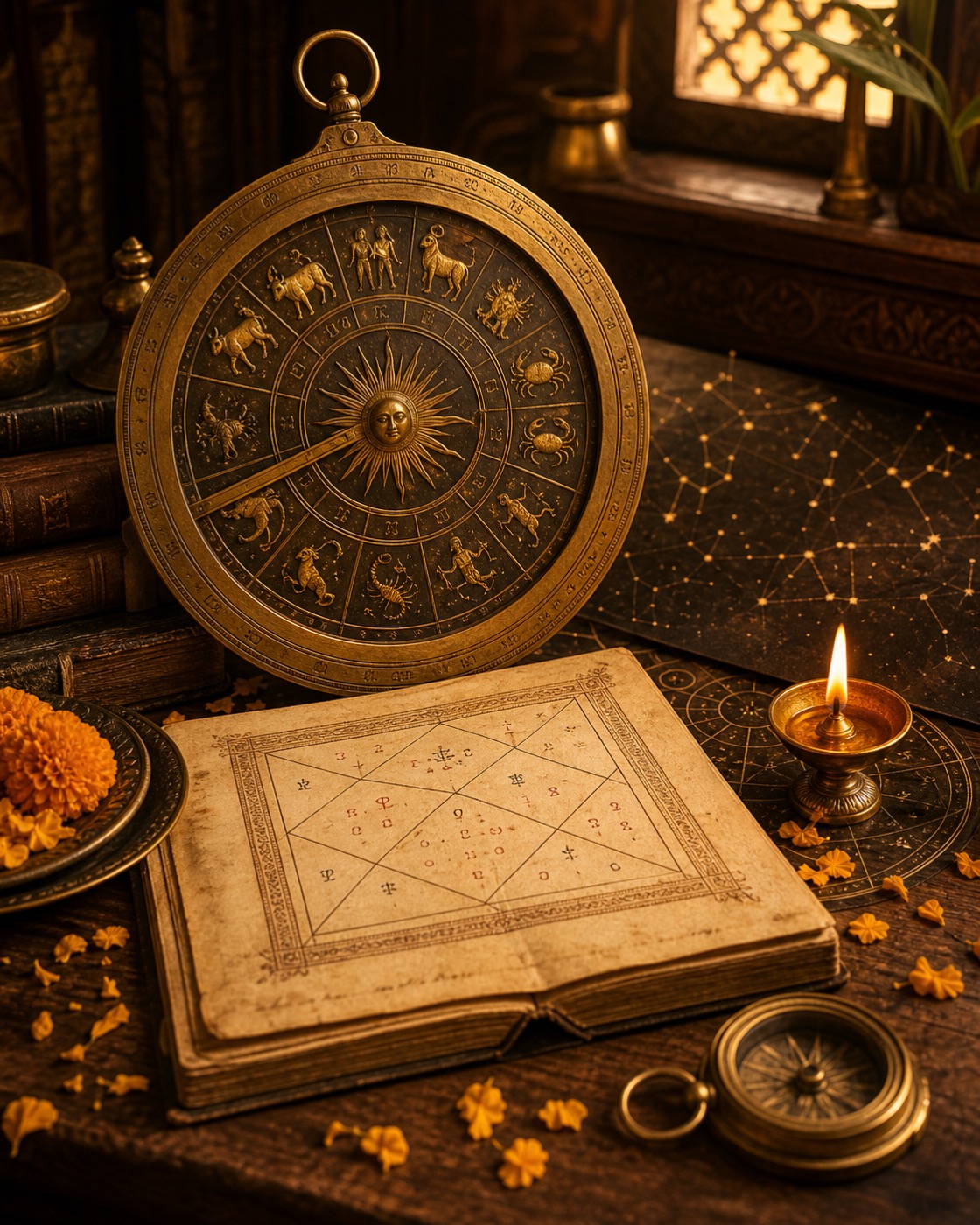
A Prashna kundli is a chart cast for the moment a question is asked, used to answer that question when birth details are missing or unreliable. The lagna stands for the person asking, the house of the matter (karya bhava) and its lord for the question, and the Moon for the mind behind it. A connection between the lagna lord and the karya bhava lord, such as a Tajik ithasala, tends to support the
When Prashna is the right tool
Every practising astrologer meets the client without a birth time, or with three different birth times from three relatives. Others arrive with one sharp question that the natal chart answers only in general: will this property sale go through, should I accept this job offer, where did the document go?
Prashna (horary) answers the question from the chart of the moment it is asked, and you can cast and analyse that exact moment's chart directly on Bodhlok Vedic astrology software. Classical sources include Prashna Marga, the Kerala text that is still the standard reference, and Prashna Tantra attributed to Neelakantha in the Tajik tradition. Krishnamurti Paddhati later added its own horary method by number.
Casting the Prashna chart
- Time: the moment the question is asked or clearly understood by the astrologer.
- Place: commonly the astrologer's location, where the question is received.
One sincere question. Traditional guidance is that the question should be genuine, asked once, and not repeated to test the result. Combine a muddled set of worries into one clear question before casting.
Watch Free Guide :- Prashna Kundali को समझने के लिए Free Kundali Software | Analyse a Prashna Kundali in Hindi | Bodhlok
The core reading
1. Lagna and lagna lord: the querent
The ascendant and its lord represent the person asking. A strong, well-placed lagna lord tends to show someone able to act on the matter.
2. Karya bhava and karyesh: the matter
Identify the house of the question: the 10th for a job, the 4th for property, the 7th for a partnership or marriage proposal, the 2nd for money, and so on. Its lord is the karyesh.
3. The connection between them
The central question in Prashna is whether the lagna lord and the karyesh connect:
- Ithasala (Tajik): an applying aspect within orbs, the faster planet moving towards the slower. It tends to show the matter coming together.
- Isharafa: a separating aspect, often read as a matter that has already passed or a chance that has gone.
- Exchange or conjunction of the two lords also tends to support the matter, depending on dignity.
- No connection at all suggests the matter needs more effort or another route.
4. The Moon
The Moon shows the querent's mind and the flow of events. Its applying aspects, its strength and its relation to the karya bhava are read carefully; many practitioners treat the Moon's next aspect as the next development.
5. Strength and afflictions
Benefics in the kendras and a strong karyesh tend to support a positive answer; a karyesh that is combust, debilitated or hemmed in by malefics tends to show obstacles. As always, these are tendencies read together, not one rule taken alone.
A sample question
Sample question: "Will the job offer I am considering come through?"
- Cast the chart for the moment the question is received.
- The 10th house is the karya bhava; note its lord.
- Check whether the lagna lord applies to the 10th lord (ithasala) or has already separated.
- Read the Moon's next applying aspect and its relation to the 10th.
- Judge the strength of the 10th lord before giving the answer, and say it in terms of likelihood, never certainty.
KP horary by number
In Krishnamurti Paddhati the querent gives a number from 1 to 249. Each number corresponds to one of the 249 sub-divisions of the zodiac, which fixes the ascendant; the rest of the chart is cast for the moment of judgement. The answer then rests on the sub-lord of the relevant cusp and the houses it signifies, confirmed by the ruling planets. Many astrologers use KP horary when they want a crisp yes-or-no structure.
Learn More: KP Horary Astrology: Sub-Lords and Horary by Number
On the desk
Bodhlok's Question chart tab holds both methods:
- Prashna by the moment, cast for the time and place of the question.
- KP horary by number, 1 to 249, with sub-lords, significators and ruling planets.
- Tajik ithasala and other yogas flagged between the relevant lords.
Ask the question box, and the consult lists what it read: the lagna lord, the karyesh, the Moon and the rule applied. Open each one and check the reasoning before you decide what to tell the person in front of you.
Try it on a sample question
Open your free desk at bodhlok.com, cast a Prashna chart for a sample question, and find the lagna lord and the karyesh before you read anything else.
Frequently asked questions
What is a Prashna kundli?
A Prashna kundli is a horary chart cast for the moment a question is asked. It answers that specific question and is especially useful when the birth time is unknown.
Which place is used for a Prashna chart?
Commonly the astrologer's location, where the question is received, at the moment it is asked or understood.
What is ithasala in Prashna?
Ithasala is a Tajik term for an applying aspect within orbs between two planets. Between the lagna lord and the lord of the matter, it tends to show the matter coming together.
How does KP horary by number work?
The querent gives a number from 1 to 249, which fixes the ascendant in one of the KP sub-divisions. The answer is judged from the relevant cusp's sub-lord, its significations and the ruling planets.
Which books teach Prashna?
Prashna Marga is the classical Kerala reference, and Prashna Tantra covers the Tajik approach. K. S. Krishnamurti's readers cover KP horary.
Bring the method to a sample chart
Open the desk, load a sample chart and follow the steps above screen by screen. The free desk has everything this guide uses.