Bodhlok's AI works in four layers, in order. A calculation engine computes positions, houses, divisional charts, dashas and strengths. A rule engine applies classical principles and Asttrolok's teaching framework. A context engine selects what matters for the question asked. Only then does a language model write the evaluated result in Hindi or English. The language model calculates nothing, and
Last updated: October 2026.
Many astrologers have tried asking a general chatbot about a chart. The language is fluent. The planetary positions are often wrong, the dasha dates are invented, and rules are applied that do not fit the chart. That is not surprising: a language model predicts plausible text. It is not an ephemeris, and it does not know which of a thousand classical rules applies to this person's question.
Bodhlok was built the other way round. In one line: the LLM does not invent astrology; Bodhlok gives the LLM astrology. Calculation first, rules second, context third, language last.
Layer 1: the calculation engine
Everything starts with numbers that must be right. The calculation engine computes planetary positions with the Swiss Ephemeris, using the ayanamsa the astrologer chooses (Lahiri by default; the KP ayanamsa for KP work). From those positions it calculates:
- the lagna and houses, including Bhava Chalit (house cusps)
- the Shodashavarga divisional charts, from D1 to D60
- Vimshottari, Ashtottari and Yogini dashas to the pratyantar, and Jaimini Chara dasha
- Shadbala and Ashtakavarga
- KP cusps, star-lords and the 249 sub-lords
The language model does none of this. It never sees a birth time and guesses a position.
Layer 2: the astrology rule engine
Correct numbers are not yet astrology. The rule engine decides which classical principles apply to the data in front of it: which yogas are formed and whether they are cancelled, whether a planet is debilitated with neecha bhanga, which houses a dasha lord rules and occupies, how strong it is. The framework follows classical sources such as Parashara and Jaimini and the teaching methodology of Asttrolok founder Alok Khandelwal.
Jyotish's rules are not new and must not be new. What is new is how quickly the applicable ones are found and connected.
Layer 3: the context engine
A chart contains far more than any one question needs. The context engine lets the question decide what matters.
A career question pulls D1, the 10th house and its lord, the related houses, D10 (Dashamsha), the strength of the relevant planets, the running mahadasha and antardasha, and relevant transits.
A relationship question pulls a different set: the 7th house and its lord, Shukra and Guru as karakas, D9 (Navamsha), the running dashas and transits over the relevant points.
This is the step that saves an astrologer the most time, because it mirrors what an experienced practitioner does in their head: set aside what is irrelevant to the question and hold the rest together.
Layer 4: the language model
Only now does a language model enter. It receives structured, already-evaluated information (these placements, these rules, this dasha, these strengths, for this question) and turns it into readable language in Hindi or English. Its job is communication. It does not add placements, invent rules or decide outcomes.
Why the order matters
If you start with… | You risk… |
|---|---|
Language | Fluent text about positions that are not in the chart |
Calculation only | Correct numbers with no sense of which rules apply |
Rules without context | A list of every yoga in the chart, relevant or not |
Calculation, rules, context, then language | An explanation the astrologer can check against the chart |
Three words sum it up: Calculate. Connect. Communicate.
AI with the astrologer, not instead of the astrologer
Think of a scan in a specialist's clinic. It gives the specialist better information; the decision stays with the specialist. Bodhlok's AI consult works the same way. It gives the astrologer better information and better context, faster. The person in the consultation is a human being with circumstances, not a kundli, and the final judgement is always the astrologer's.
That is also why the AI consult is built for practising astrologers and serious students, not for the public looking for a quick prediction.
Where it lives on the desk
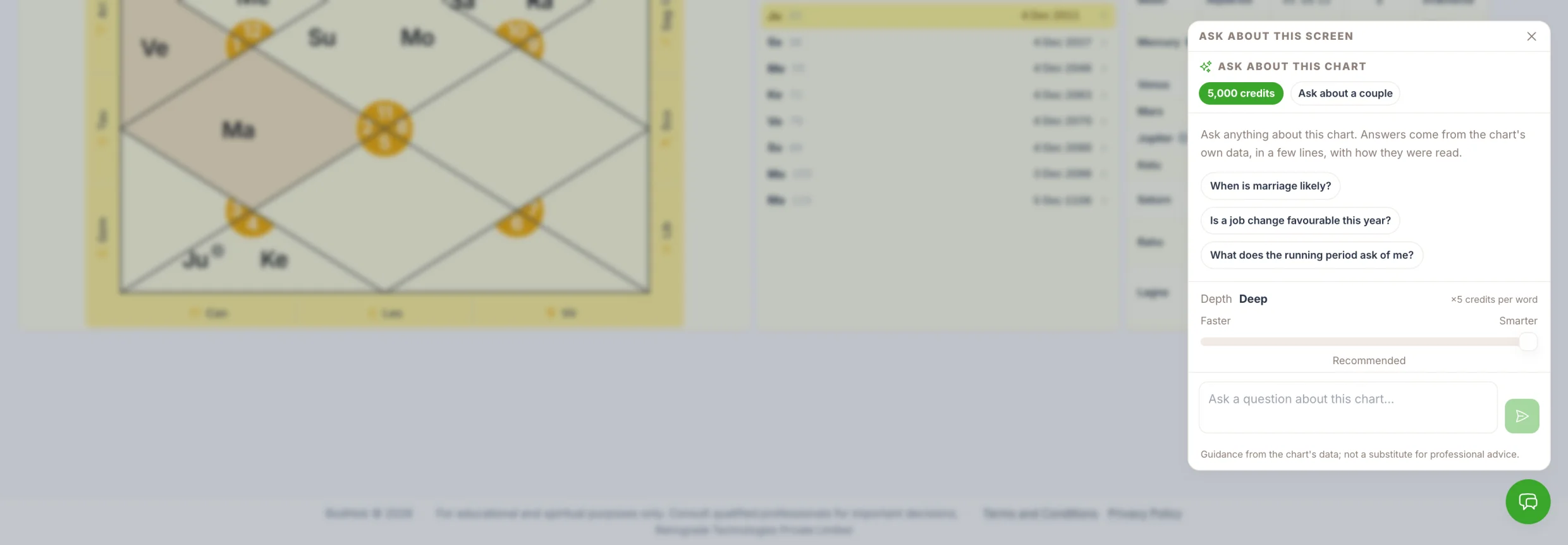
On any chart, open the AI consult and ask a question in Hindi or English. The desk shows the charts, dashas, strengths and rules it drew on, so you can follow the demo order yourself: question, relevant charts, dasha, strength, rules, context, language output. Check each point on the chart; use what holds up in your own words.
Privacy
Birth details and consultation notes are private. Use sample charts when you test or demonstrate the AI consult, and keep client data in your own account.
Try it on a sample chart
Open your free desk at bodhlok.com, load a sample chart, and ask a career question. Then check every factor it names against the chart.
Ancient Wisdom. Structured Intelligence. Human Judgement.
Frequently asked questions
Which Vedic astrology software has an AI assistant?
Bodhlok has an AI consult in Hindi or English for astrologers and students. It explains a chart that has already been calculated and evaluated against classical rules; the language model does not calculate.
Can ChatGPT calculate a birth chart correctly?
A general language model is not an ephemeris and can produce wrong planetary positions or dasha dates. Reliable chart work needs a calculation engine such as the Swiss Ephemeris before any language model is involved.
Does Bodhlok's AI make predictions instead of the astrologer?
No. It gives the astrologer organised, rule-evaluated information for a question. The judgement, and what is said to a client, stays with the astrologer.
Which classical rules does the rule engine use?
It follows classical principles from sources such as Parashara and Jaimini, organised through Asttrolok founder Alok Khandelwal's teaching methodology.
Can the AI consult answer in Hindi?
Yes. The language layer writes the evaluated result in Hindi or English.
Compare on a real chart
Open a free desk, bring a sample chart, and see the calculations, timing tools and consult side by side with whatever you use today.