A career astrology analysis moves in a fixed order: state the question, read the 10th house and its lord in the D1 and the D10, check the running mahadasha and antardasha, test the strength of the planets involved through Shadbala and Ashtakavarga, apply the classical rules that fit, add the transit context, and only then put the answer into words as a tendency, with the reasoning kept open.
Why the order matters
Career is the question clients ask most after marriage, and it is easy to answer badly: one striking placement, one confident sentence. A reading that holds up follows a sequence, because each layer can overturn the one before. A good 10th lord can be weak in strength, out of dasha, or under a difficult transit. The sequence below is the one Bodhlok's desk and consult are built around: question, charts, dasha, strength, rules, context, language.
The chart here is illustrative: a set of placements chosen to teach the method, not a real person's chart.
1. The question
Write it precisely. "What about my career?" is not a question a chart can answer well. "Is a change of job indicated in the next twelve months, and is service or independent work better supported?" is. The wording decides which houses and periods matter.
2. The relevant charts
Illustrative chart: Simha lagna.
- D1: The 10th house is Vrishabha; its lord Shukra sits in the 11th in Mithuna. The Sun, lagna lord and natural karaka of authority, is in the 10th. Shani, lord of the 6th (service) and 7th (partnerships and business), is exalted in Tula in the 3rd.
- D10 (Dashamsha): Shukra falls in a kendra of the D10, and the D10 lagna lord is not afflicted.
First reading: the 10th lord in the 11th links career with gains, and Shukra's position in the D10 supports the D1 promise.
3. The dasha
Running: Shukra mahadasha, Shani antardasha. The mahadasha lord is the 10th lord, so career matters are active through this period. The antardasha lord rules the 6th and 7th, the two houses that separate the "service" and "independent work" parts of the question. Check the pratyantar dashas inside the antardasha for narrower windows.
4. Strength
- Shadbala: Shukra's total is above its classical minimum of 5.5 rupas, so it can deliver; Shani is also above its minimum of 5.
- Ashtakavarga: the Sarva Ashtakavarga bindus in the 10th and 11th signs are above the average of 28, and Shani's own Bhinna Ashtakavarga shows good bindus in the signs it will transit during the antardasha.
Strength confirms that the period lords can act, not just that they are well placed.
5. The rules
Which classical principles apply to this question?
- A dasha of the 10th lord tends to bring the 10th house's matters forward.
- When the antardasha lord rules the 6th, service and employment themes often dominate; as 7th lord it can also bring partnership or client-facing work.
- A planet exalted and strong in its antardasha tends to give the results of its lordships well.
The rule layer is where a reading becomes checkable: each conclusion is tied to a named principle.
6. The context
Now the transits. Suppose Guru is transiting the lagna and aspects the 5th, 7th and 9th, while Shani's transit sign has good bindus in its Bhinna Ashtakavarga. Transit supports what the dasha promises; it does not create a promise the chart lacks. The context engine on the desk pulls exactly this set for a career question: D1, the career houses and lords, the D10, strengths, the running mahadasha and antardasha, and the relevant transits.
7. The language
A careful answer to the illustrative question might read: "The running period activates career matters, and the antardasha points towards a change within employment, possibly with more responsibility for clients or partners. The strongest window falls where the pratyantar and the supportive transit overlap." It speaks in tendencies, names its basis, and leaves room for what the astrologer knows about the person.
The same sequence on the desk
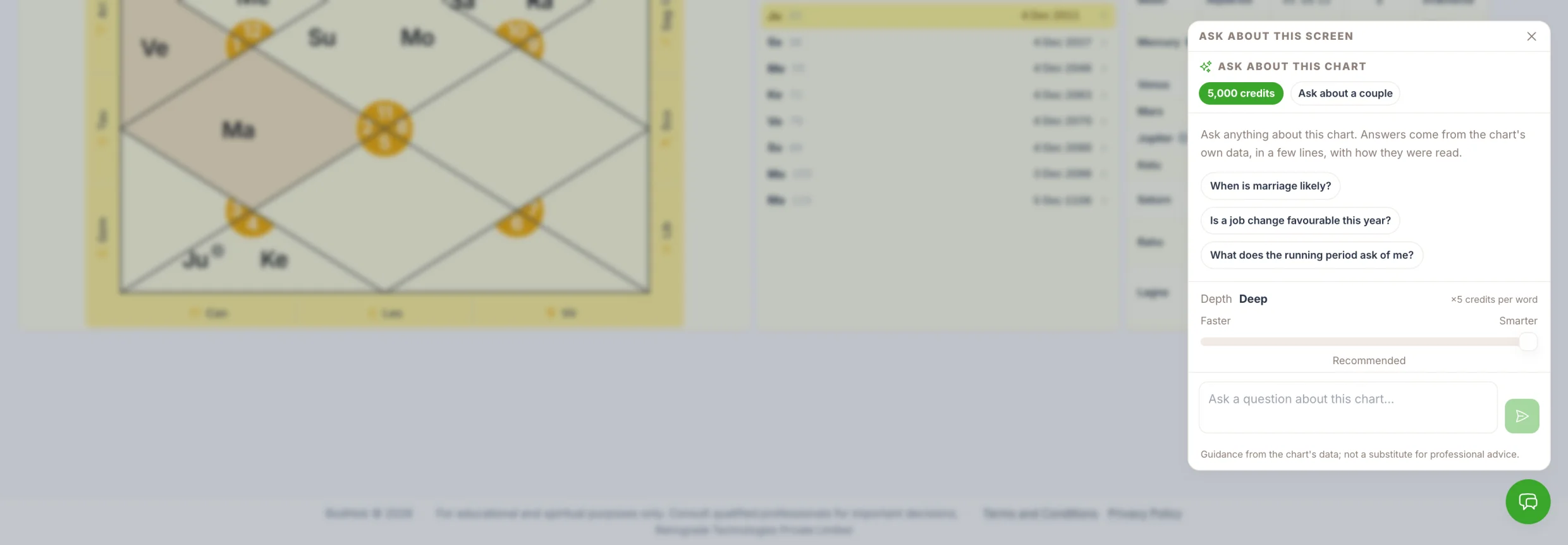
On Bodhlok, the running period is visible on every screen, the D10 opens beside the D1, Shadbala and Ashtakavarga are a click away, and the transit chart sits over the natal. Ask the question in the consult box and the answer lists what it read: chart, dashas, transits and the rule applied. Open each one and check the work. The judgement remains yours.
Try it
Take a sample chart and walk the same seven steps for a career question. Open your free desk at bodhlok.com.
Frequently asked questions
Which house shows career in Vedic astrology?
The 10th house and its lord are the primary indicators of career, read with the 6th (service), 7th (business and partnerships), 2nd and 11th (income and gains), and the D10 divisional chart.
What is the D10 chart used for?
The Dashamsha (D10) refines the D1 10th house: practitioners check where the 10th lord and career karakas fall in it and whether the D10 lagna and its lord are strong.
How do dashas show a career change?
Periods of planets connected to the 10th, 6th, 7th or 11th houses tend to bring career matters forward. Pratyantar dashas and supporting transits help narrow the window.
Do transits alone predict career events?
No. Transits generally activate what the natal chart and the running dasha already promise; they are read as context, not as the basis of a career judgement.
What order should a career reading follow?
Question, relevant charts (D1, D10), dasha, strength (Shadbala, Ashtakavarga), rules, transit context, then language. Each step can qualify the one before.
Bring the method to a sample chart
Open the desk, load a sample chart and follow the steps above screen by screen. The free desk has everything this guide uses.