
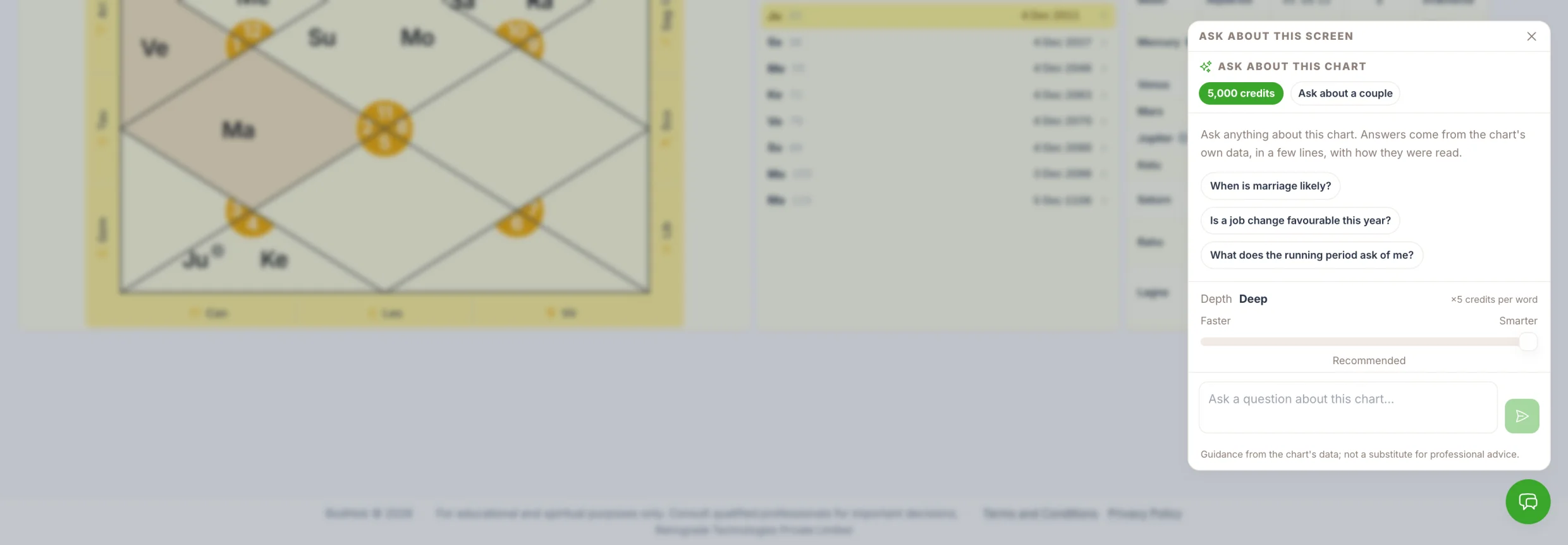
An AI astrology consultation in professional software should assist the astrologer, never stand in for them. In Bodhlok, the consult answers only after the chart, dashas, transits and strengths have been calculated and the relevant classical rules applied; the language model then writes the result in Hindi or English. Every answer lists what it read, so the astrologer can open each source on the
The worry practitioners raise first
When astrologers first see an AI consult, the question is rarely "is it clever?" It is "can I trust it in front of a client?" That is the right question. A language model on its own does not know where a planet is, which dasha is running, or which rule applies. Asked about a chart, it will produce fluent text either way. For a professional, fluent text with no traceable basis is a liability.
So the useful question is not whether software has an AI assistant, but what the assistant is allowed to do and what it shows you.
What a trustworthy consult should do
A checklist worth applying to any AI feature in astrology software:
- It should not calculate. Positions, houses, vargas, dashas and strengths should come from an ephemeris-based engine, not from the model.
- It should apply named rules. The step between calculation and language should be an explicit rule layer you could, in principle, inspect.
- It should select context by question. A career question needs the 10th house and its lord, the D10, strengths, the running mahadasha and antardasha and the relevant transits. A marriage question needs a different set.
- It should show its sources. Each answer should say which chart, period, transit and rule it rests on.
- It should admit uncertainty. When the chart does not clearly support an answer, it should say so.
How Bodhlok's consult is built
Bodhlok follows that order in four layers: a calculation engine (Swiss Ephemeris, your chosen ayanamsa), a rule engine built on classical principles and Asttrolok's teaching framework, a context engine that decides what the question needs, and only then a language model that writes the already-evaluated result. As the founder puts it, the language model does not invent astrology; the desk gives it astrology. Our article "How Bodhlok's AI Works" walks through each layer.
Using it inside a consultation
A practical routine many testers settled on during the eighteen months of building:
- Do your own first read. Look at the D1, the running period and the main transit before you type anything. The consult is a second pair of eyes, not the first.
- Ask from the tab you are on. The question box sits on every tab, so a question raised while you are in the D9 or the dasha table can be asked there, without breaking the line of the reading.
- Choose the depth. Quick for a yes-or-no on prepared facts, Standard by default, Deep for difficult questions.
- Open what it cites. Each answer lists what it read: the chart, the dashas, the transits and the rule applied. Open the cited period on the dasha screen and the cited transit on the transit chart. If you see the same thing, you have a reasoned answer. If you do not, you have found the point to think harder about.
- Disagree when you should. You know things the chart does not: the client's circumstances, what they have already tried, what they can hear today. The consult has no access to those unless you write them down.
- Choose the language. Answers come in English or Hindi. Use the language that suits the client, and keep the substance you have checked.
What stays with you
The final judgement, the wording you use with a client, and every decision about what not to say. A consult answer is an indicative reading built on classical rules; it does not guarantee an outcome, and neither should you. Questions touching health, pregnancy or fertility need particular care: astrological guidance only, not medical advice.
For teachers
In a class, the consult is most useful in reverse: ask it a question on a sample chart, then have students find each cited factor on the desk and judge whether the rule was applied well. Students learn the method by auditing the answer.
Credits and depth
The consult uses credits by depth; the current rates and allowances are set out in our article on how the consult works and on the Pricing page.
Try it
Open the sample chart, ask a career question at Standard depth, and check every source it lists. Open your free desk at bodhlok.com.
Frequently asked questions
What is the astrologer's role when using an AI consult?
The astrologer reads the chart, checks the sources the consult cites, weighs the client's circumstances and decides what to say. The AI organises calculated, rule-checked information into language; the judgement stays with the astrologer.
Which Vedic astrology software has an AI assistant?
Several products now offer AI features. Bodhlok's consult is built into a professional desk: it answers from the calculated chart, dashas and transits, applies classical rules, and lists the sources it read so the astrologer can check them.
Does the AI calculate the chart?
Not in Bodhlok. The calculation engine computes positions, houses, divisional charts, dashas and strengths; the language model only writes the evaluated result in Hindi or English.
Can the AI consult answer in Hindi?
Yes. Bodhlok's consult answers in Hindi or English, and the Hindi interface and Hindi consult answers are available on every plan.
How do I check an AI consult answer?
Open each source the answer lists, such as the running dasha, the transit and the chart factor, on the desk and see whether you reach the same reading.
Bring the method to a sample chart
Open the desk, load a sample chart and follow the steps above screen by screen. The free desk has everything this guide uses.