
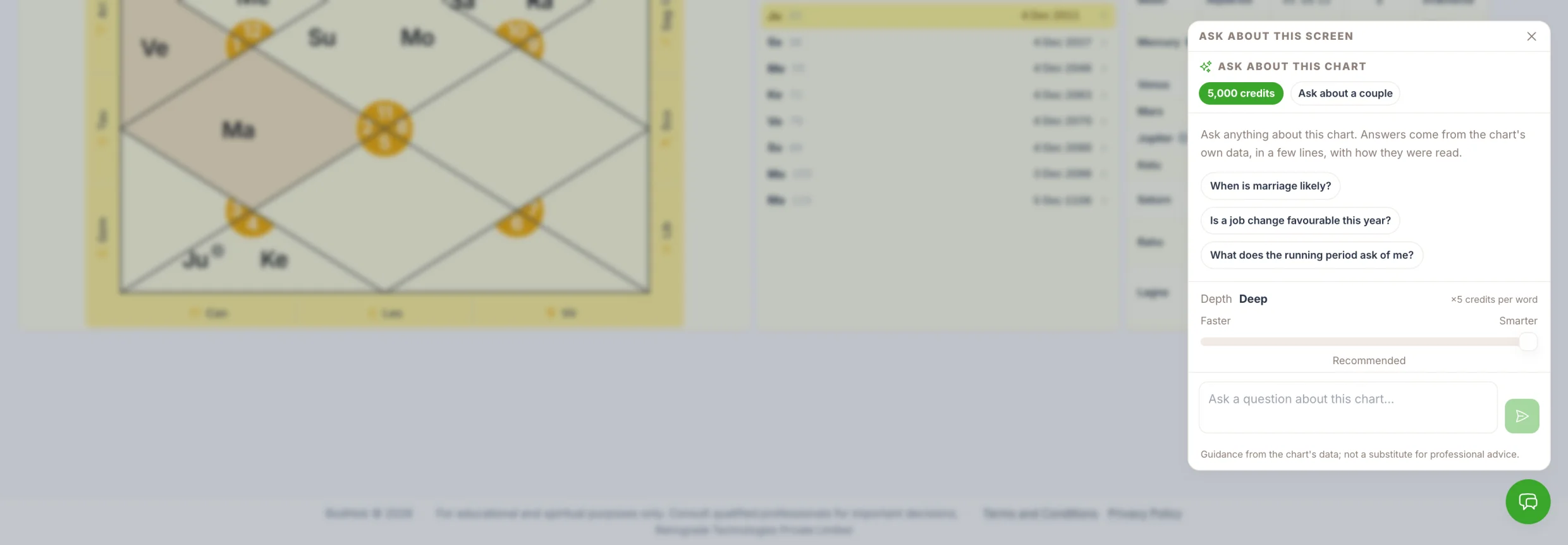
The consult is a question box that sits on every screen. It is not a chatbot with an astrology vocabulary; it reads the chart, periods and transits of the native (the person whose chart is being read) before it writes a word.
What it reads
Before answering, the consult assembles the native's facts (sex, age, what is known about marriage and work), the D1 with conjunctions and the planets with the mahadasha lord, the divisional charts the question needs, the current and past sub-periods, the transits and their ingress dates, the strength tables, and the rules of the remedy rulebook for the question's domain. At Standard and Deep depth it can also fetch any screen of the desk and read the engine's own source to check a definition. That reach is the same recipe the astrologers' Lab uses when it reviews a reading.
The shape of an answer
Every answer follows one shape: a line restating what you asked, two to four short paragraphs in time order anchored on periods with the months in bold, and a closing line with the likely outcome. About 90 to 130 words, in plain language, in English or Hindi. The astrology that justified it (the houses, the lords, the dasha logic) is kept with the answer rather than printed inside it, so a client reads a reading and an astrologer can still check the working.
Three depths
| Depth | What happens | Credits per word |
|---|---|---|
| Quick | One pass over the prepared facts. Good for a yes-or-no. | 1 |
| Standard | Fetches the screens it needs and checks the engine. The default. | 2 |
| Deep | The fullest reading on the strongest model, for the hard questions. It can take up to a minute. | 5 |
How credits are counted
A question costs the words in it plus the words in the answer you read (the paragraphs, never the working), multiplied by the depth's rate: one at Quick, two at Standard, five at Deep. There is a floor of twenty words per question, so a one-word reply still pays for the reading behind it: 20 credits at Quick, 40 at Standard, 100 at Deep. A typical Standard answer of about 110 words to a 15-word question costs around 250 credits, so a 1,000-credit allowance is three to four Standard answers or seven to eight Quick ones. Plans include a monthly allowance (1,000, 3,000 or 5,000 credits); bought credits are spent after the allowance, and the pack terms shown at purchase give their validity.
What it will not do
It will not invent a window it cannot anchor on a period or a transit, it refuses to answer in the wrong language, and it says when the chart does not support a confident reading. If it cannot read a screen it says so instead of guessing.
Try it on your own chart
Open any native, pick Standard, and ask: 'When will my work settle?' The answer names the sub-period and the transit it rests on.